
Screening and follow up of ROP
- Introduction...
- 1. Learning object...
- 2. Whom to screen?...
- 3. When to screen?...
- 4. ROP screening: ...
- 5. Preparation of ...
- 6. Preparation of ...
- 7. Planning follow...
- 8. Linking with RB...
- 9. Key messages...
 |
 |
Introduction
DR. AMANPREET SETHI
MD, DM (Neonatology)
Assistant Professor
Department of Pediatrics
All India Institute of Medical Sciences
New Delhi
1. Learning objectives
â–º Whom to screen?
â–º When to screen?
â–º Who will screen?
â–º How to prepare a baby for screening?
â–º How to plan follow up?
2. Whom to screen?
Infants with either of the following
♦ Birth weight less than 2000 grams OR
♦ Gestation age less than 35 weeks OR
Any preterm infant with following risk factors
♦ Cardio-respiratory instability
♦ Prolonged oxygen therapy
♦ Repeated episodes of apnea of prematurity
♦ Blood transfusion
♦ Sepsis
♦ Poor postnatal weight gain
3. When to screen?
â–º First screening at 4 weeks of age
â–º For infants between 24-30 weeks GA /Birth weight < 1200
gram: 2-3 weeks after delivery (Not later than 3 weeks)
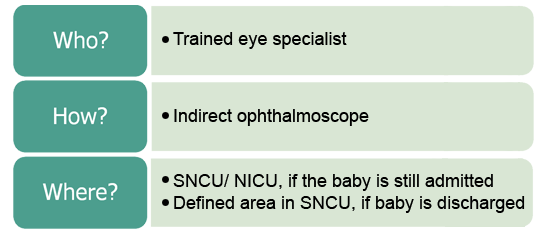
4. ROP screening: Place, person and equipment
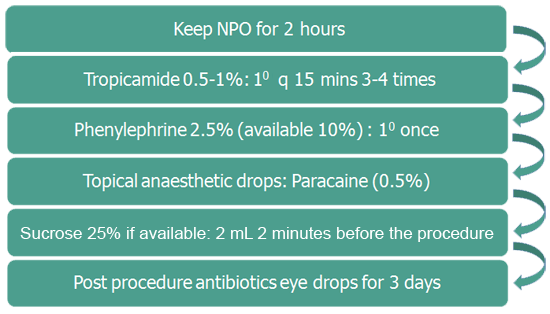
5. Preparation of babies prior to screening
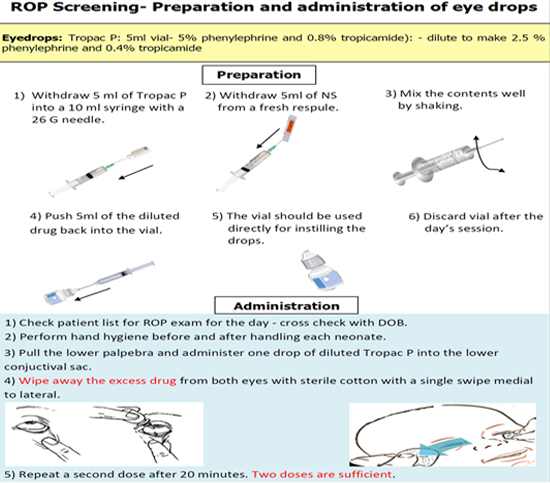
6. Preparation of babies prior to screening 2
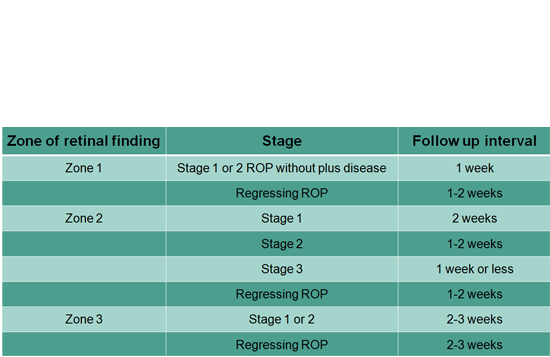
7. Planning follow up interval
8. Linking with RBSK
â–º Improve coordination and financial support
â–º Provision of equipment to screen and treat
â–º Long term follow up can be streamlined by involvement
of front line health workers
â–º Improvement of rehabilitation/referral services
9. Key messages
â–º ROP screening should be done at 4 weeks after birth
â–º Infants born earlier than 30 weeks/ birth weight <1200
grams: do examination at 2-3 weeks
â–º The screening should be done by trained
ophthalmologists using indirect ophthalmoscope
â–º The frequency of follow up depends upon the zone and
stage of ROP